An escape room game used to mean a booking, a drive, and 60 minutes you could not rewind. I still love those rooms. But after watching a $100,000 build, a solo CIA-themed run, and a PowerPoint version of the exact same idea, I keep landing on one point: the puzzle logic matters far more than the room. And that logic fits on a phone.
- 🎯 Design over decor: great escape room games win on puzzle logic, not expensive sets.
- 📱 No venue needed: a phone, a link and a QR code replace the lock box.
- 🔗 Chain your locks: a five-lock trail turns any message into a game.
- 💡 Hints keep players in: well-timed hints stop people from quitting the puzzle.
Here is my thesis, up front. The best escape room game you play this year might be one you build yourself. Not because DIY is fashionable, but because everything that makes an expensive room work (a clear goal, escalating puzzles, well-timed hints) costs nothing to copy. The pricey part is the set, and the set is the first thing players forget.
What a $100,000 escape room game actually teaches you
MrBeast built what he called the world's most dangerous escape room: ten levels, a $100,000 prize, and a timer counting down the whole time. The spectacle is the spikes, the snakes and a Minecraft level where a flaming arrow lights a TNT block. Strip that away and every level is one clean puzzle. In the library level, over 1,000 books line the walls, but only a single title (an Elon Musk book) opens the trap door. That is the whole craft: one clear objective per stage, and rising pressure.
Disguised Toast, running an 8-out-of-10 CIA-themed room solo, said it even better. Figure out your input and your output, because "that's all an escape room is." He cracked the number lock by counting the lit lamps on the ceiling: four lights, four digits. According to the listing on theescapegame.com, that room runs 60 minutes for up to eight players with a 35% success rate, and he cleared it alone in about 56 minutes.
Players remember the click of a solved lock, not the wallpaper.
What makes an escape room game actually fun?
It is not the theme. It is the tension between a goal you understand instantly and a path you have to uncover. Toast wasted 15 minutes organizing a shoe puzzle that the game master later admitted was broken, and that moment is the clearest lesson in the whole video: a puzzle only works if it has a real, findable answer. Give players a goal they get in one sentence, then hide the route. Do that and the theme barely matters.
The three ways people play escape room games right now
If the puzzle is the product, the format is just packaging. And right now there are three kinds of packaging on the shelf, each with a real trade-off.
First, live venues. theescapegame.com has run since 2014 and now cites 24 themes, over 10 million players and 50+ locations, with "no limits, no penalties, no judgement" on hints. Brilliant for a night out, but it is priced per head and it is one-and-done: you cannot replay the room you just solved.
Second, video games. crazygames.com notes that the genre "started with real-life experiences" and moved online, often free and often built for two players. Escape Simulator ships 28 rooms plus a level editor and community-made levels, according to xbox.com. In Sync, per the Games Puff roundup, is a two-player game you solve without words, using only shapes, colours and symbols. Reusable and clever, but screen-bound.
Third, kits and templates. Jeff at Your Learning Career runs a full game called Escape the Breakroom entirely inside PowerPoint: fully editable text, a green check and red X for right and wrong answers, and an hourglass slide when time runs out. Cheap and customizable, but you have to babysit the slides as the host.
| Format | Typical cost | Setup | Players | Reusable |
|---|---|---|---|---|
| Live venue room | $30 to 40 per player | Just book | Up to 8 | No, one-and-done |
| Video game | ~$20 once | Install on PC | Solo or co-op | Community rooms |
| Boxed / PowerPoint kit | $10 to 30 | Read the script | Small teams | Edit the text |
| Virtual-lock trail | Free to start | Paste content, share link | Unlimited | Fully, in minutes |
SOURCE : theescapegame.com, xbox.com, Your Learning Career (YouTube) · MAJ 08/2026
Which format should you pick?
It depends on what you want: a night out, a game to replay, or something you can bend to your own content. The escape room barely existed as a category before 2014, and industry trackers like Statista now follow it as a mature market. That maturity means the formats above are all solid. But none of them let you drop your own message, link or photo behind the puzzle, which is exactly what most of my readers actually want.
Why I build my own escape room game with virtual locks
Full disclosure: I run Lock Challenge, so I am biased toward virtual locks. That is also why I know precisely where they fall short. A virtual lock is the same puzzle as a padlock, minus the hardware. You hide content (a birthday message, a discount code, a photo, a link) behind a lock the player opens on their phone. No printing, no box, no drive to a venue.
What can you actually hide behind a virtual lock?
The practical range is wider than a physical lock box, too. Lock Challenge offers 12 lock types, from numeric and pattern to colours, directional, musical, switches and even GPS, and you share the whole thing as a short link or a QR code. That last part matters: a GPS lock only makes sense when the "board" is a park, not a table.
I am not going to pretend this is a mass phenomenon yet. On lockchallenge.com over the last 30 days I count 76 organic clicks and an average Search Console position of 14.8 for this topic. Modest numbers, and I am telling you honestly. But the point is the keyword is winnable and the mechanic clearly resonates with the people who do find us.
« The room is set decoration. The puzzle is the product. Build the second one well and you barely need the first. »
The Lock Challenge team, August 2026
How do virtual locks compare to a physical lock box?
A physical lock is tactile and satisfying, and for an in-person room it is hard to beat. But it is single-use, it needs resetting between groups, and it cannot travel down a link. A virtual lock trades that tactile click for reach: you can send it to a classroom, a remote team or a party guest, and reset it with one tap. I dug into the full trade-off in our guide to virtual vs physical locks, because the honest answer is "it depends on whether your players are in the same room."
A five-lock trail you can build this afternoon
Remember MrBeast's escalation: each level was harder than the last. You can copy that with a chain of locks, where each solved lock reveals the clue to the next. Here is a trail I would build for a birthday hunt, one idea per mechanic, so you can steal the structure and swap the content.
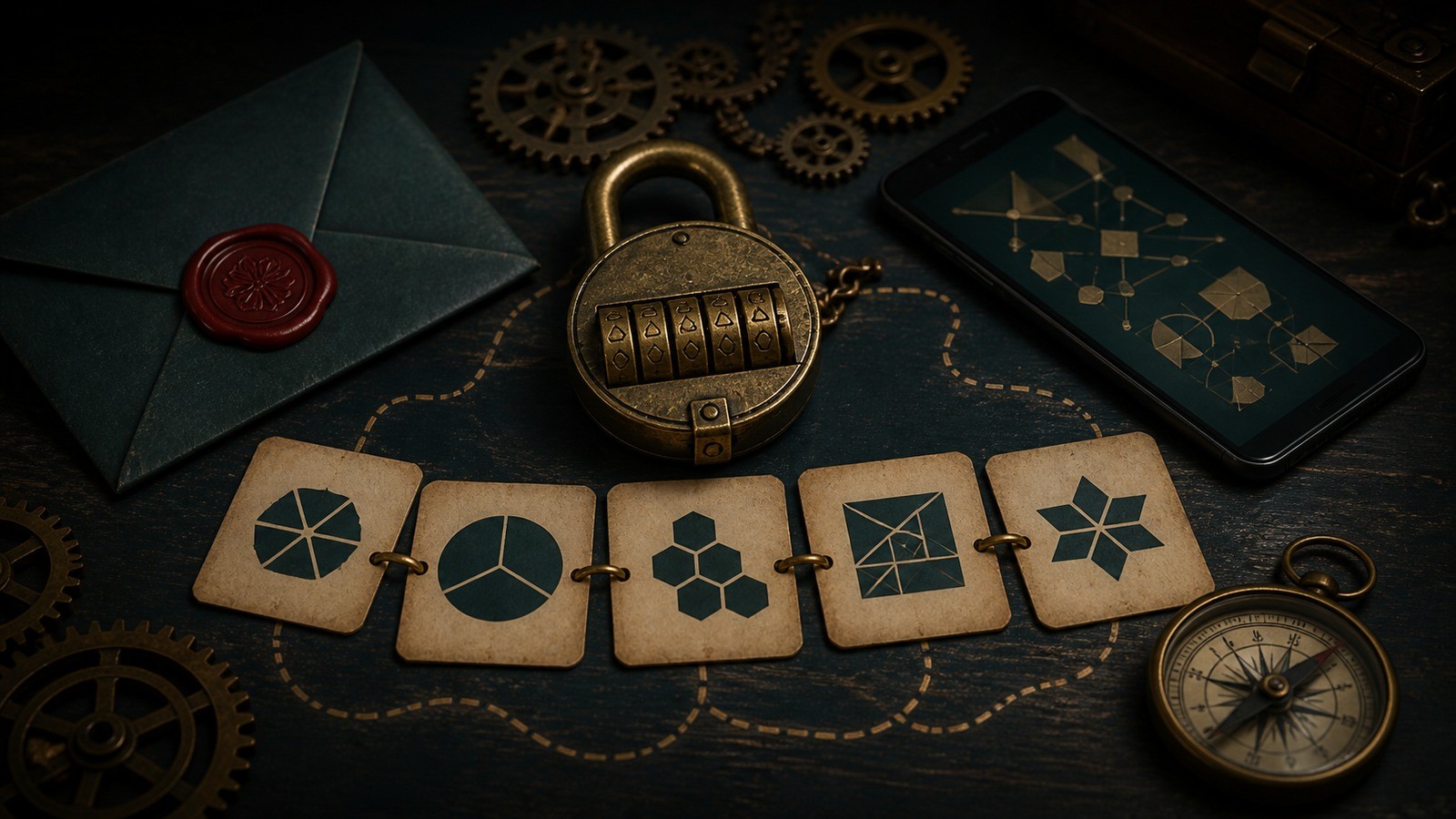
Lock one is numeric: enter the birthday year to unlock the first clue. Lock two is colours: rearrange four colours pulled from a family photo, revealing a room in the house. Lock three is pattern: draw the shape of a local landmark to point players outside. Lock four is musical: tap out the first bar of their favourite song. Lock five is GPS: walk to the exact spot where you hid the gift, and the final reveal opens on the phone.
Each reveal is the clue to the next lock, so the five stand as a single multi-lock trail rather than five separate puzzles. If you want ready-made riddles to fill each stage, our post on treasure hunt clues for adults includes 24 riddles and a worked five-lock trail, and 50 clue ideas sorted by puzzle type covers every lock mechanic above. The plumbing is the same whether you are hiding a gift, a link or a lesson.
How do you keep a lock chain from getting too hard?
Hints. This is the one thing every good escape room game gets right and most DIY ones forget. theescapegame.com brags about unlimited hints "no limits, no penalties, no judgement," and Jeff's PowerPoint game hands the host a full set of facilitator hints for every puzzle. Write one hint per lock before you launch, and test the whole chain on someone who has never seen it.
A puzzle nobody solves is not hard, it is broken.
That broken shoe puzzle cost Toast 15 minutes of real frustration. The fix is boring and non-negotiable: play your own trail end to end before anyone else touches it. So, would I ever go back to a boxed game? For a night out with friends, absolutely, the venues earn their price. But for a classroom, a team offsite, a proposal or a product launch, I build my own now. Most people typing "escape room game" get pushed toward a booking or a $40 box. The better answer, more often than you would think, is a link you made yourself in an afternoon. If you want to try it, start with a single numeric lock and a message behind it, then add a second lock once the first one clicks. Our full walkthrough on how to build a digital escape game takes it from there.
FAQ
What is an escape room game?
An escape room game is a puzzle challenge where players solve a series of clues to reach a goal, usually against a timer. It started as physical rooms you book in person, but the same structure now runs as video games, printable kits, and phone-based trails built from virtual locks. The core is always the same: a clear objective, a hidden path, and puzzles that gate your progress.
How much does it cost to build your own escape room game?
It can cost nothing to start. A physical room runs $30 to $40 per player and a boxed kit is $10 to $30, but a virtual-lock trail is free to build and share with a link. You only pay if you want advanced features, and even then a lifetime plan is a one-time cost rather than a per-player ticket.
What kinds of locks can you use in a digital escape room game?
Far more than a padlock offers. On Lock Challenge you can use numeric, pattern, directional, colour, musical, switch, login and GPS locks, among 12 types in total. That range lets you match the lock to the setting, like a GPS lock for an outdoor hunt or a musical lock for a party clue.
How long should an escape room game take to play?
Most professional rooms run 60 minutes, and that is a good ceiling for a serious challenge. For a home or classroom game, 20 to 40 minutes usually keeps energy high without losing anyone. If you are chaining locks, count on three to five minutes per lock and test the full trail to check the real timing.
Can you run an escape room game remotely or online?
Yes, and that is the biggest edge of virtual locks. Because the whole game lives behind a link or QR code, you can send it to a remote team, a classroom or a party guest anywhere. Everyone plays on their own phone, and you can reset the game instantly for the next group.
Sources
- World's Most Dangerous Escape Room! — MrBeast
- Make Team Building FUN With a PowerPoint Escape Room! — Your Learning Career
- Can I beat this CIA Escape Room... Solo? — Disguised Toast 2
- 10 Best Escape Room Games 2025 — Games Puff
- America's #1 Escape Room | The Escape Game — theescapegame.com
- Escape Games 🔐 Play on CrazyGames — crazygames.com
- Play Escape Simulator | Xbox Cloud Gaming — xbox.com