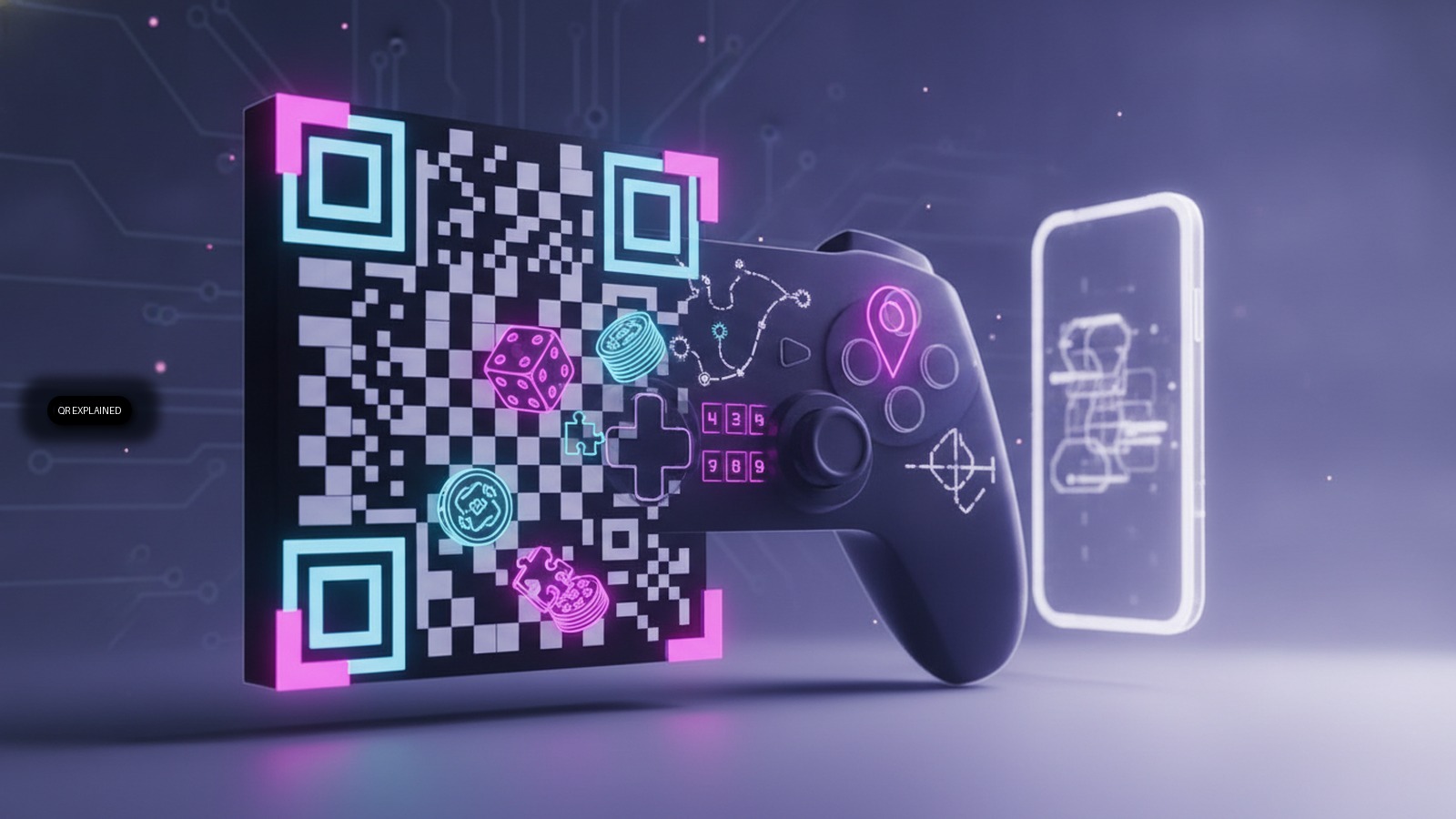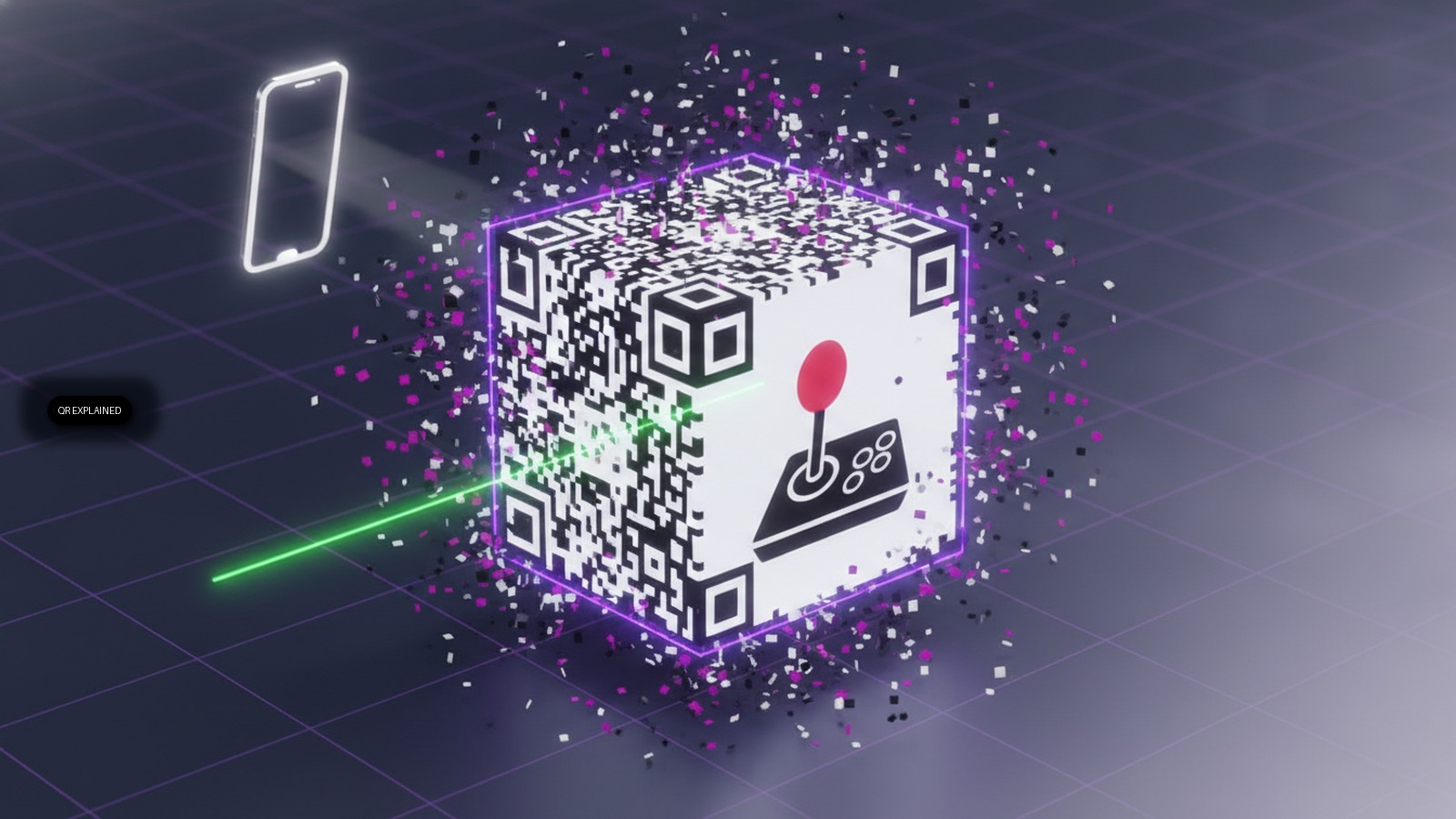
Search "QR games" and you'll get two completely different answers. One is a coding stunt: cramming an entire playable game into the black-and-white square itself. The other is what teachers, event planners, and marketers actually build: a code that triggers a hunt, a reveal, or a puzzle hosted somewhere else. Only one of those scales past a novelty video, and mixing them up is why most homemade QR games fall apart on the day.
- 📦 The 3KB ceiling, a QR code tops out around 2,953 bytes, too small to hold a real game.
- 🔗 Trigger, not storage, working QR games use the code as a link that fires a hosted experience.
- 🧩 Worked example inside, a 5-code office scavenger trail, laid out step by step.
- ⚠️ Common failure, one skippable code can collapse an entire QR game in minutes.
We've watched people push the stunt version to its absolute limit, and we've built the second kind for real events. Both are worth understanding, because the limits of the first explain exactly why the second exists.
The 2,953-Byte Wall Nobody Mentions
A QR code is just a storage medium, the same way a floppy disk or a hard drive is, only much smaller. Version 40, the largest standardized size at 177 by 177 modules, caps out at 2,953 bytes. YouTuber MattKC measured that ceiling against everyday files: a single Windows notification sound clip runs 11 KB, four times over budget before you've written a line of game code.
That number isn't a rough estimate. Three separate creators, MattKC, Aywen, and Game of Tobi, each hit the same 2,953-byte wall while trying to fit a playable game into one code, and each had to bleed features to get under it.
How much can a QR code actually store?
Not much, by modern standards. A 1.44 MB floppy disk holds roughly 500 QR codes' worth of data. An Atari 2600 cartridge, built for hardware from 1977, still had more room at 4 KB. MattKC built a working Snake game in x86 assembly and later in C, and even after stripping the executable with the /NODEFAULTLIB linker flag, he landed at 3.1 KB, still too big. He only closed the gap with executable packing, the same compression trick used in demoscene 1 KB and 4 KB demos, to squeeze the final build under the limit.
Game of Tobi went further and built a walking 3D Minecraft clone using a raycasting engine originally written for the Game Boy Advance. To fit it, he cut jumping entirely, stripped standard HTML boilerplate a browser doesn't strictly require, and shortened every variable name to a single character. The result loads as a base64 data URL, and on iOS it needs the Brave browser's built-in scanner, since the stock camera app refuses to open raw data links.
Aywen took a different route for a 2D Minecraft-style build: instead of texture images, he used emoji as terrain tiles. A 16-by-16 pixel dirt texture costs 841 bytes on its own; the emoji equivalent costs 4, because the device already has it stored. He also swapped full hex color codes for the 3-character shorthand version, shaving bytes one character at a time until the whole game, menu included, fit the frame.
What a QR Game Actually Is (Hint: It's Not Storage)
None of that scarcity applies to the QR games people actually run at events, in classrooms, or on a game night. The code isn't the game. It's the trigger. Scan it, and a phone opens a link to something hosted elsewhere: a webpage, an app, a lock screen, a leaderboard entry. The 2,953-byte ceiling stops mattering the moment the code only has to carry a URL.
That's exactly the model behind Netflix's TV game controller setup, where scanning the on-screen code pairs a phone as a controller instead of loading any game logic at all, the code is a handshake, nothing more. It's also the model behind the board game Chronicles of Crime, where players scan codes on physical cards to unlock case clues and interview suspects on their phone, according to qrcodekit.com's rundown of the mechanic. The cardboard stays simple; the story lives online.
You'll find a longer breakdown of this trigger model, including why it beats the storage approach for anything with more than one step, in what actually makes a QR game work. The short version: once the code is just a link, you can chain as many of them as the experience needs.
| Model | What lives in the QR code | Where the real game runs | Best for |
|---|---|---|---|
| Code-as-storage stunt | Full game logic, compressed to fit | The phone or browser, offline | A novelty demo, not repeat play |
| Code-as-trigger link | A short URL | A hosted lock, quiz, or reveal page | Scavenger hunts, classroom games |
| Code-as-pairing handshake | A session token | A TV, console, or app already running | Controller pairing, live events |
SOURCE : MattKC, Aywen, Game of Tobi, Fix Forum transcripts · MAJ 08/2026
A Worked Example: Five Codes, One Office Scavenger Trail
Here's how the trigger model plays out in practice. We laid out a five-code trail for a 30-minute team-building scavenger hunt: one QR code per floor of an office, each one opening a different lock mechanic rather than a static answer page.
Code one sits at reception and opens a numeric lock tied to the year the company was founded, printed nowhere obvious, so players have to ask someone. Code two, on the second floor, opens a color-pattern lock matching the brand's palette on a poster down the hall. Code three swaps to a directional lock, four arrows in sequence, hidden behind a plant near the break room. Code four is the twist: a musical lock, where the tune is the office's hold music, forcing a call to the front desk. Code five, back at the start, opens the final reveal, a leaderboard showing every team's solve time.
How do you keep players from skipping ahead?
Chain the codes so each unlock only reveals the location of the next one, rather than posting all five locations up front. That single choice is what separates a scavenger trail from a checklist. QR Gamez applies the same logic to its Digital Egg Hunt format, where each scanned code updates a running score and flags duplicate scans, since unlimited players sharing the same set of codes only works if cheating is designed out from the start, not patched in afterward.
Loquiz's list of twenty scavenger hunt formats leans on the same trigger principle across very different settings: a museum hunt sticking codes to display glass, a city tour swapping GPS pins for codes on lamp posts, even a T-shirt hunt where guests scan each other. Every version reuses the same mechanic from the office trail above, only the surface changes.
Where Homegrown QR Games Break
The failure mode we see most often isn't a scanning problem, it's a design problem: one code that gives away the answer to the next step, or worse, one skippable code that lets a fast team finish the whole trail without solving anything. Guidebook's own scavenger hunt documentation flags this directly, noting that a QR game only holds attention when finishing it requires finding and scanning every code, not just the fastest one.
Reddit turns up the same lesson from hobbyists building their own systems. One developer's World of Qreatures devlog on r/MonsterTamerWorld describes generating unique in-game creatures from scanned QR codes, with the same code always producing the same result, deterministic by design, so that trading and breeding stay fair. A separate Pokémon Fluvio ROM hack thread on r/PokemonROMhacks shows a QR code used purely to share a team roster between players, again pure trigger, zero storage. Both projects avoid the mistake Guidebook warns about: neither one lets a shortcut bypass the actual mechanic.
We build and sell lock mechanics for exactly this kind of chained QR trail, so take the next point with that in mind: the fix for a skippable code is almost never a better QR code, it's a lock that won't open without the right input. A numeric, pattern, or musical lock behind each scan forces engagement the link alone can't. That's the gap between a QR game that gets solved in ten seconds and one that holds a room for thirty minutes.
« The QR code was never the hard part. Getting someone to actually solve something before it opens is. »
The Lock Challenge Team, August 2026
QR code adoption for marketing and live events has kept climbing as scanning moved from a dedicated app to a native camera feature, a shift Statista has tracked across its research on code-based marketing for several years. That's exactly why the trigger model wins: nobody has to install anything for code one, two, three, four, or five to work.
So when someone asks whether a QR game means code stuffed with a compressed executable or a link into a hosted lock, the honest answer is almost always the second one. The byte limit that forces MattKC, Aywen, and Game of Tobi into brutal trade-offs is irrelevant once the code only has to carry a URL. Build the trail as a chain of locks instead of a stack of answer pages, hide the next clue behind the current one, and a thirty-second scan becomes a thirty-minute game.
Frequently Asked Questions
Can a QR code really contain a playable game?
Yes, technically, but only a tiny one. The largest standard QR code holds 2,953 bytes, which is enough for a stripped-down Snake or a basic walking simulator, not a full game with save states, sound, or complex logic. Creators who've done it had to cut features like jumping or block-placing just to fit.
What's the difference between a QR game and a regular QR code link?
A regular QR code link opens a single static page. A QR game chains multiple codes together, where scanning one only reveals where or how to find the next, often gated behind a lock, quiz, or challenge rather than a plain link.
Do players need to install an app to play a QR game?
No, if it's built the trigger way. Any phone camera that reads QR codes can open the link, and the actual game, lock, or quiz runs in the browser. The storage-stunt version is the exception, since a few of those require a specific browser like Brave to open raw data URLs.
How many QR codes should a scavenger trail have?
Enough to sustain the time slot without dragging. A five-code trail runs comfortably in 20 to 30 minutes for a small team; larger group events, like museum or city-tour hunts, often stretch to a dozen or more codes across a longer route.
Why do some QR games let people cheat by skipping steps?
Usually because every code and its location were listed up front instead of chained. Once players can see the full list, the fastest scanner wins without solving anything. Locking each reveal behind the previous step's solution closes that gap.
Sources
- Can you fit a whole game into a QR code? — MattKC
- J'ai codé Un Jeu dans ce QR Code (oui vraiment) — Aywen
- Can I fit Minecraft into a SINGLE QR CODE??! — Game of Tobi
- Cómo escanear el código QR para jugar juegos de Netflix en la TV — Fix Forum
- QR Gamez – Scanning QR Codes to play games — qrgamez.com
- QR codes in board games: Enhance interactivity and immersion — qrcodekit.com
- QR Code Scavenger Hunt Game — support.guidebook.com
- QR Code Scavenger Hunt: 20 ideas for your events — loquiz.com
- I built a Monster Tamer game that lets you scan real-world QR codes — r/MonsterTamerWorld
- [Pokémon Fluvio] New Update (v0.1.10): Generate a QR code in the PokéNav — r/PokemonROMhacks