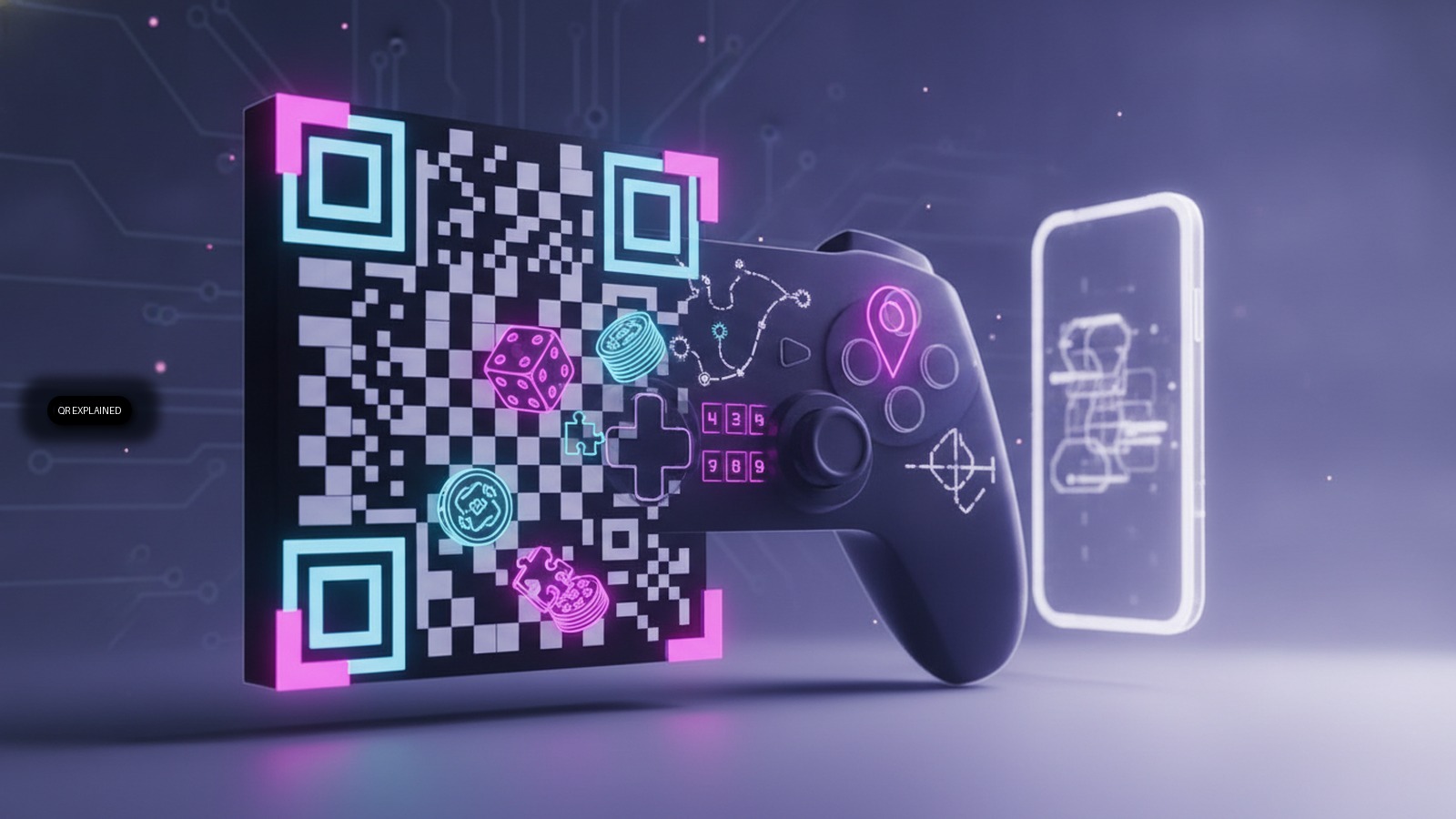
QR games are one of the most misunderstood formats in event and classroom design. Most people assume the code somehow "contains" the game, the way a cartridge contains a program. It doesn't. A QR code is a doorway, and what's on the other side of that doorway decides whether the game actually works.
- 🔑 QR codes barely hold data, a maxed-out code stores about 2,953 bytes, so almost every QR game is really a link, not a file.
- 🎲 Board games already nailed this, Boss Fighters QR scans physical cards to fight ten different bosses, no manual reading required.
- ⚠️ Switching devices mid-game breaks things, reviewers have had to restart entire sessions jumping from phone to tablet.
- 🚀 A five-lock trail beats a single scan, chaining QR-triggered locks turns one code into a full narrative arc.
That confusion matters because it leads people to build the wrong thing. They spend hours designing a beautiful code and forget the experience it opens needs to survive a shaky wifi signal, a cracked phone screen, and a group of ten-year-olds all scanning at once.
QR games aren't code in a box, they're doorways
A QR code is technically a storage medium, the same category as a floppy disk or a hard drive, just far smaller. YouTuber MattKC put a number on that ceiling in a widely watched experiment: the largest standard QR code, version 40, holds roughly 2,953 bytes. That's not a typo. Less than 3 kilobytes.
To put that in perspective, MattKC pointed out that a single Windows click sound effect is 11 KB, nearly four times the size of the biggest QR code on the market. A 3.5-inch floppy disk from the Windows 95 era held 1,474,560 bytes, enough space for almost 500 maxed-out QR codes stacked together.
How much data can a QR code actually hold?
Enough for text, never enough for a real app. MattKC actually built a playable Snake game that fit inside a QR code's size limit, but only by minifying HTML and JavaScript down to nothing and stripping every unnecessary character. French creator Aywen ran a similar experiment squeezing a 2D Minecraft clone into a code, and hit the exact same wall: the moment he added a menu, he'd already burned through most of the 2,953-byte budget.
A QR code is technically just a storage medium like any other. It's just as legitimate as a floppy disk, CD, or even hard drive.
Both experiments prove the same practical point for anyone building an actual event game: don't try to cram content into the code itself. Point the code at a link instead, and let a proper web page or app do the heavy lifting. That's exactly how every successful QR game on the market is built, and it's why the platforms below all work the same way under the hood.
The QR games worth stealing ideas from
Once you accept that a QR code is just a trigger, the design space opens up fast. QR Gamez runs a digital egg hunt where printed eggs hide codes around a property; scanning one adds points, a raffle entry, or occasionally a penalty if you land on a "bad egg." No app install, no manual, just a phone camera.
Loquiz documented 20 event formats built the same way, from museum trails where codes sit behind glass cases to city tours that replace GPS pins with printed stickers on landmarks. SocialPoint and Scavify both build scavenger-hunt platforms around the identical mechanic: scan, earn points, watch a leaderboard update live on a screen at the venue.
What makes Boss Fighters QR work so well?
The board game Boss Fighters QR shows the model at its most refined. Nominated for the 2026 Kennerspiel des Jahres, it has players scan character and item cards with a tablet camera to battle ten bosses, each with its own attack pattern and weaknesses the group has to figure out together. Reviewer Gioconauta from the Gioconauta channel called it "more of a video game than a board game," and the comparison holds: the cards are cheap and disposable, but the app carries all the actual complexity, the exact same split MattKC and Aywen landed on for their own QR experiments.
The lesson for anyone running a classroom or corporate event is the same one Chronicles of Crime, cited in a QRCodeKIT piece published June 16, 2025, built its reputation on: keep the physical components minimal, and let the scan reveal the story. The physical prop stays cheap. The scan carries the weight.
Building your own QR game with a lock trail
A single scan is a novelty. A chain of scans is a game. That's the core idea behind a lock trail: instead of one QR code unlocking one reward, you print or display a sequence of codes, each one launching a virtual lock that has to be solved before the next code becomes readable.
How do you chain five locks into one QR game?
Here's a scenario we've seen work well in a workshop setting: five stations placed around a room or hallway, each with a printed QR code. Scanning the first code launches a numeric lock (a simple 4-digit combination hidden in a poster on the wall). Solving it reveals the second code. That one triggers a color-pattern lock tied to a prop on the table. The third is a directional lock that only makes sense once players notice the arrows painted on the floor. The fourth swaps to a musical lock, a short tune players have to replay from a hummed clue. The fifth and final code opens a GPS lock, sending the group to one last physical location to claim the reward.
Each mechanic forces a different kind of thinking, and the trail format means nobody finishes early and gets bored while the rest of the group catches up. The table below breaks down which mechanic fits which context, so you're not guessing.
| Game Type | How It Works | Best Setting | Setup Effort |
|---|---|---|---|
| Single scan reveal | One code, one reward | Gift reveals, invites | Very low |
| Digital egg hunt | Scattered codes, points per scan | Parties, family events | Low |
| Multi-code scavenger hunt | Codes tied to locations, leaderboard | Corporate events, campuses | Medium |
| Lock trail (chained) | Sequential locks gate each next code | Classrooms, escape games | Medium |
| App-driven card battle | Cards scanned into a companion app | Board game nights | High |
SOURCE : transcripts cités, QR Gamez, Loquiz, Scavify · MAJ 08/2026
Chaining mechanics like this is exactly what turns a static QR code game into something closer to a real digital escape game. If you're planning something outdoors, swap one of the middle locks for a GPS trigger; it changes the entire pace of the session because players have to physically move to progress, not just think.
The mistakes that kill a QR game mid-session
Even a well-designed trail collapses if the technical side isn't tested first. Gioconauta's Boss Fighters QR playthrough is a useful cautionary tale: the group started the session on a phone, realized mid-game that a tablet gave more screen real estate, and had to restart the whole match from scratch because the app didn't carry state between devices. That's an hour lost to a decision that should have been made before anyone sat down.
Why do QR games fail across devices?
Platform mismatches are the most common failure point. On Reddit, a player in the r/DBLegendsReddit community described being stuck on an in-game QR event entirely because they played on PC, where there's no camera to scan a code, and had to request a 19-character alphanumeric substitute instead. Another thread in r/3dspiracy asked how to even scan a QR code on a handheld console that has no built-in camera app for it. Neither problem is about game design. Both are about assuming every player has the same hardware.
Test your QR game on the cheapest phone in the room, not the newest one. If a scan requires a specific app instead of a browser, half your players will bail before they even see the first puzzle. Loquiz's own scavenger-hunt writeup makes the same point from the organizer's side: their most reliable formats need nothing but a phone's default camera, no app download, no login screen standing between the player and the first clue.
On lockchallenge.com, our own Search Console numbers back this up in a small but honest way. As of May 2026, the phrase "online lock for escape room" ranks at position 1.0 with a single click so far, a tiny sample, but it tells us organizers are actively searching for exactly the browser-based, no-download model this article is describing, not app-heavy alternatives.
The takeaway that actually matters
QR games work when the code is treated as a trigger, not a container. Every example in this piece, from Boss Fighters QR to a five-lock classroom trail, splits the job the same way: a cheap, disposable scan on one side, and a browser-based experience carrying the real logic on the other.
If you're building your first one, start smaller than you think you need to. One QR code, one virtual lock, one reveal. Once that works reliably on three different phones, chain in a second lock. The escape room clues list is a good place to pull puzzle ideas from once your trail structure is solid, and if you're still deciding between a printed lock and a digital one, the tradeoffs are laid out in our virtual vs physical locks comparison. According to Statista's ongoing research into mobile scanning behavior, QR code usage has kept climbing year over year since 2020, which means the audience for this format isn't shrinking. Build for the cheapest phone in the room, and the rest takes care of itself.
Frequently Asked Questions
Can a QR code contain a full playable game?
Technically yes, but only a tiny one. MattKC fit a working Snake game into roughly 2,953 bytes, the maximum a version 40 QR code holds, by stripping the code down to bare HTML and JavaScript. For anything more ambitious, the practical approach is a QR code linking to a hosted game or web app rather than embedding the code itself.
What's the difference between a QR scavenger hunt and a QR lock trail?
A scavenger hunt scatters codes across locations and usually just tracks points as players find each one. A lock trail chains codes together so that scanning one only becomes possible after solving a puzzle unlocked by the previous code, which creates a stronger sense of narrative progression.
Do players need to download an app to play a QR game?
Not if it's built well. The most reliable QR games, including the scavenger hunt platforms from Loquiz and SocialPoint, run entirely in a phone's default browser after a scan. Requiring a dedicated app install is one of the fastest ways to lose participants before the game even starts.
Why did a QR game fail when players switched from phone to tablet?
Most QR games tied to a specific app store session don't carry progress across devices. A Boss Fighters QR review documented exactly this problem, forcing a full session restart. Testing on one consistent device throughout a session, or choosing a browser-based format instead of an app, avoids the issue entirely.
What's the best QR game mechanic for an outdoor event?
A GPS-triggered lock tends to work best outdoors because it forces physical movement between clues, which suits open spaces better than a code taped to a single spot. Indoor events, by contrast, tend to favor numeric or pattern locks that don't depend on location accuracy.
Sources
- Can you fit a whole game into a QR code? — MattKC
- Nominiert für das Kennerspiel des Jahres 2026: Boss Fighters QR — Spiel des Jahres
- BOSS FIGHTERS QR - Tutorial and gameplay example — Gioconauta
- J'ai codé Un Jeu dans ce QR Code (oui vraiment) — Aywen
- QR Gamez – Scanning QR Codes to play games — qrgamez.com
- QR codes in board games: Enhance interactivity and immersion — qrcodekit.com
- QR Code Scavenger Hunt: 20 ideas for your events — loquiz.com
- QR Code Scavenger Hunt | Game Builder Platform — socialpoint.io
- Scavify: QR code game that engages event attendees — scavify.com
- Buenas, necesitaba ayuda para completar el evento de busqueda de shenron — r/DBLegendsReddit
- Can someone upload the QR codes for these games in Spanish? — r/3dsqrcodes
- Como para scanear cod QR de juegos nintendo3ds — r/3dspiracy