What is a multi-step QR escape game?
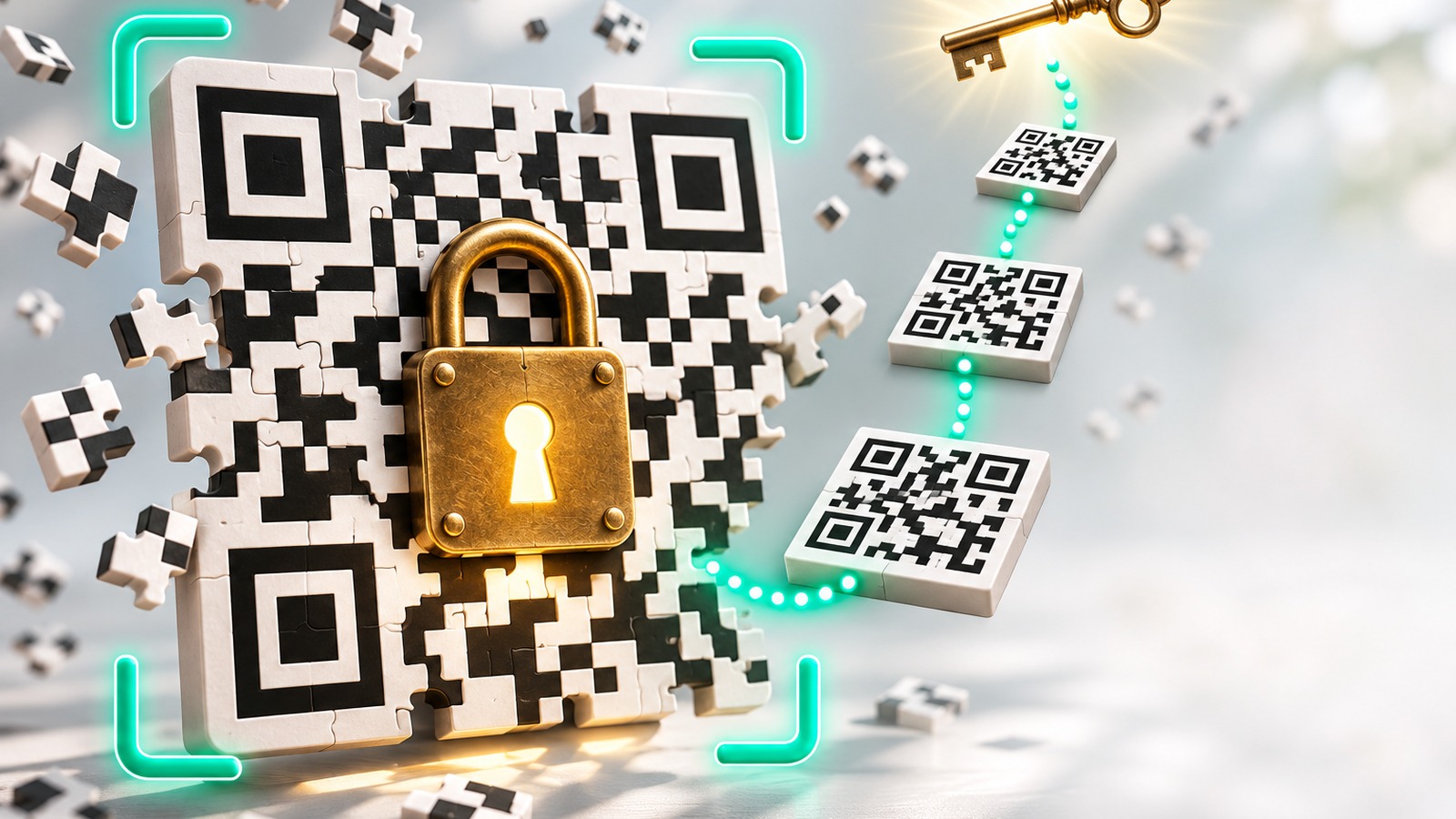
A multi-step QR escape game is a digital escape game in which several locks are chained into one trail and each lock is reached by scanning a QR code on a phone. Players never install anything: the code opens a link, the link shows a lock, and solving the lock reveals the next clue.
How does it differ from a single QR code puzzle?
A single QR code hides one piece of content behind one answer. A multi-step game turns the reveal of each lock into the clue that points to the following one, so the team moves through a space, a building or a series of screens.
The idea is not new. On Steam, the game QR Escape from QR Mosaics asks you to solve puzzles that construct a QR code, and scanning it returns a 6-digit password (according to its Steam store page). That is the same loop you reproduce for a real team: puzzle, code, scan, new lock.
Why does the chain matter more than the codes?
QR Tiger lists 9 ways to use codes in escape rooms, among them hidden clues, challenge checkpoints, audio hints and a progress tracker, and notes that the Room Escape Artist 2025 industry report counts over 2,000 escape room facilities in the United States (QR Tiger). Those ideas all work, but each one is a single moment.
A chain gives the team a reason to keep moving. Each answer is a small win, and the final reveal feels earned because five locks came before it.
How do you build a five-station trail?
Build the trail backwards: decide what the final reveal is, then write each lock so it hands over the location or the content of the next QR code. A five-station trail fits a 45-minute session for teams of five, and it works in an office, a hotel or a remote call.
I use the corporate scenario of a product launch day. The team has to find the launch announcement locked in a trophy display case.
What does each station look like?
Each station pairs one lock mechanic with one hidden clue, and the mechanics differ on purpose so the team never repeats the same gesture. Lock Challenge supports numeric codes, patterns, colours, musical locks, GPS and switches, so you can mix them freely.
Source: worked example by Lock Challenge · Updated 11/2026
Station 5 is the only code the team assembles from earlier answers, which forces them to share information instead of splitting up.
What do players see when the last lock opens?
For this scenario I pick the trophy display case, the filmed unlock animation used by the team-building template. When the right code lands, the case opens on video, with sound, and the launch announcement appears inside the opened object, followed by a celebration such as confetti or fireworks.
Lock Challenge locks open with filmed unlock animations: the object opens on video, with sound, when the right answer lands. On a meeting-room screen, that finale is the moment a provider would normally charge for. You can try the exact opening in the team-building template, and see every filmed object on the custom virtual lock page.
When you are ready to build your own, start creating your challenge from the team-building page. You can build and preview a lock before paying anything.
How do you hand off from one QR code to the next?
The hand-off is where most homemade games fail, because a lock that reveals "go to the kitchen" gives no proof the team went there. Write each reveal as a riddle that can only be solved by looking at the place the next code sits, and keep every code physically unreachable until the previous lock is open.
How do you stop teams from skipping ahead?
Skipping ahead is the cheat that matters. Lock Challenge verifies each answer on the server, so a player who reads the page source finds nothing, and you can add an opening date to a lock if you want a station to stay shut until a set time.
Also print the codes in a different order than the route. A team that scans a code out of sequence meets a lock whose answer they do not have yet, and the clue they need is the one they skipped.
How do you keep fast teams from finishing early?
Add a team-wide meta-puzzle, as in station 5 above, and a timer. Team Battle with a live leaderboard turns the final lock into a race, and the screen at the front of the room shows who is ahead.
Playful Technology, a games designer who built a room escape for International Games Week at the Norwich Millennium Library, starts his planning video with constraints: the space, the opening hours and the public walking through (video). Copy that habit. Before you write a clue, note the wifi quality of the venue, who else uses the space, and how many phones are really on the network.
Is it cheaper to build it yourself than to hire a provider?
Building a multi-step QR escape game yourself costs time rather than a provider's quote: expect a few hours to write clues, print codes and test the route. A provider remains the better choice for large groups, physical props and on-site hosts.
When should you hire a provider instead?
Hire a professional when you have hundreds of participants, when the game needs physical logistics such as rooms and props, or when you want a live host. A DIY trail has no one to rescue a stuck team except you.
When does DIY clearly win?
DIY wins for teams of 10 to 40, for remote and hybrid groups, and for recurring sessions such as onboarding. The same trail can be reused, translated or reskinned by changing the clues and the filmed object. If you want ideas for the scenario itself, escape room team building lists eight you can run without a venue, and team building scavenger hunt covers a 60-minute format.
For wider context on spending on leisure and entertainment, Statista publishes market data by country.
Genially has a public QR code escape room by Christophe Grassaud, created on 12 May 2022, that teaches the QR code itself (Genially). It is a good example of rich decor, and where that matters more than a chain of locks, a Genially scene is the stronger tool. If you also want the basics, read how to build a digital escape game.
What should you do before the session?
How do you test the trail?
Test the whole route on your own phone, then on a colleague's phone with a different browser. The first-party data I can show is modest: on my own Search Console, the QR code games article earned 15 clicks and 203 impressions in the 30 days before 9 September 2026, so I do not claim scale, only that people do search for this format.
Take one decision now: a five-station trail with a filmed finale. Write the final reveal first, build the four locks that lead to it, print the codes, and run it once with two colleagues before the real session.
FAQ
How many QR codes does a multi-step escape game need?
One code per lock is the simplest rule, so a five-station game uses five codes. You can add a sixth hidden code as a bonus clue, but every extra code adds a test step.
Do players need to install an app or create an account?
No. Players scan a QR code or open a short link on their phone, and the lock loads in the browser. Players never pay and need no account.
Can I use different lock types in the same trail?
Yes. You can chain numeric, pattern, colour, musical, GPS and switch locks in the same trail, which keeps each station feeling different. Down the Wrabbit Hole's Christmas morning escape game uses the same idea with physical locks: a word lock, a four-digit combination lock and a key lock on one gift (video).
How much does it cost?
Players never pay and need no account. See current plans and features on the pricing page.
Can a multi-step QR game work for a remote team?
Yes. For a remote team, replace the printed codes with links shared in the call or in a slide deck, and use numeric, colour or musical locks instead of GPS. The chain logic stays identical.