Which padlocks work best in a homemade escape room?
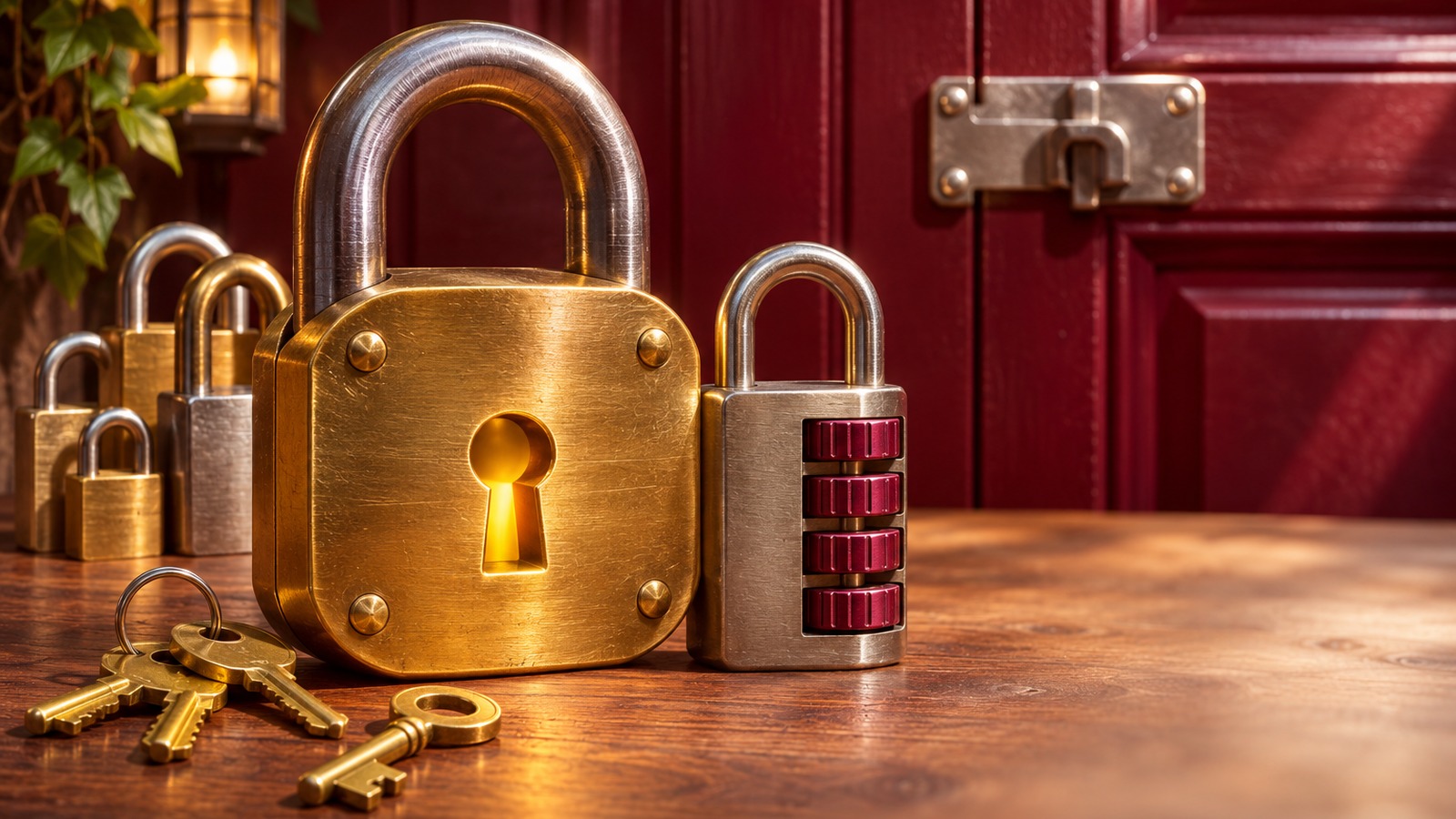
A homemade escape room needs locks that are cheap, resettable and readable in dim light. Combination padlocks, word locks and directional locks cover most puzzles, while key padlocks work for a single "find the key" beat. Here is how the main types compare.
Source: moorlocks.co.uk, lockpaperescape.com, MIMGAMES transcripts · Updated 11/2026
The "rough cost" column is a ballpark, not a quote. Prices move by country and retailer, so check before you budget.
Why is a 4-digit combination padlock the default choice?
A 4-digit combination padlock gives 10,000 possible codes, which is enough that players will not guess it by trial and error, and it accepts any number you can hide in a puzzle: a year, a locker number, the sum of three clues. Escapely and Lock Paper Escape both list it as the common starting point for a home room.
A 3-digit lock gives only 1,000 codes. At two seconds a try, a stubborn kid can get through them in about 33 minutes, so use it for early puzzles or add a rule such as "three wrong tries and you lose a hint".
Which padlock suits words, routes or hidden keys?
A word lock suits any answer that is a name or a short word. A 4-letter lock has 456,976 combinations, so it is harder to guess than a number lock, but the dials limit you to the letters printed on them.
The MIMGAMES channel points out that padlocks with both letters and colors are hard to find in shops, and suggests painting the letters with markers to adapt a standard model. A directional lock suits a route puzzle, for instance following arrows on a floor plan. A classic key padlock is best for one beat only: the key is the prize of the previous puzzle. MIMGAMES also tests a Houdini-style logic padlock that ships with two identical keys, a reminder that a lock can be a puzzle in itself, and El Templo Escape Room shows LED padlocks that signal a partial match.
Moorlocks, a UK maker, sells bespoke escape room padlocks from £35, according to its site in November 2026, with a design tool so the code does not have to be four digits. That is a good option for a room you will run many times, a poor one for a single birthday.
Pick the lock from the answer, not the other way around.
What should you check before buying escape room padlocks?
Before buying, check three things: that the code is resettable, that the lock survives rough handling, and that the shackle size fits your box or hasp. Paranoia Quest notes that padlocks are very affordable, but a cheap lock that jams mid-game costs more than it saves.
How do you know if the code can be reset?
Look for a small reset lever or button on the packaging and test it twice before the day. Some cheap models ship with a fixed code, which makes them single-use. A resettable lock is the one you can reuse for the next room, with a new story.
Always write the code on a card and keep it in a pocket. I have seen more escape rooms stall because the host forgot the code than because the players were slow.
Are padlocks safe for a kids' escape room?
For children, pick large dials and smooth edges, and keep small loose parts such as keys away from under-threes, in line with the small-parts warnings in EU toy safety rules and the US Consumer Product Safety Commission's guidance. Metal locks are also heavy: a lock dropped on a toe ends the game faster than any puzzle.
For a kids' build, I suggest fewer physical locks and one clear, big-dial lock for the final box. The same logic applies to classrooms, where counting locks and keys before and after the game matters. If you plan a full build, our step-by-step DIY escape room guide shows where each lock sits in the flow.
How do you match each padlock to a puzzle in a real game?
You match a padlock to a puzzle by asking what shape the answer has: a number, a word, a direction or an object. Chain three locks of different types so the same trick is never solved twice in a row, and keep the hardest lock last.
What does a three-lock chain look like?
Here is a pirate-themed chain for ages 8 and up, about 30 minutes:
- Word lock (opener). Clue: "I have a mouth but never eat, a bed but never sleep." The answer is RIVER. Players see the word on a torn map.
- Directional lock (middle). The map shows arrows drawn as palm trees leaning left, left, right, up. The lock opens with that sequence.
- 4-digit lock (final). The number is the year printed on a coin found in the sand box, plus a small twist the host can change next time.
The order matters: a word first lets the group warm up, the directional lock forces them to read the map together, and the final number gives everyone a shared "yes". For more puzzle ideas, see 20 escape room puzzle ideas with clues and answers, and for fresh themes, 15 escape room theme ideas.
A last note on difficulty. Escape room guides such as Stuck in the Riddle list lock families including the letter and number combo lock and the Da Vinci Code style lock. They are fun, but in a home game, fewer, clearer locks beat many exotic ones, because the host cannot hint by reading the players' faces across a locked door.
What if you have no padlock, or your players are far away?
If you have no padlock at hand, or your players are in another room, city or country, you can build the same lock online in about two minutes and share it as a link or QR code. A virtual lock verifies the answer on the server, so nobody can read the code off the hardware.
Lock Challenge is a platform for building virtual locks: numeric, pattern, directional, colors, musical, switches, login, GPS, Sudoku and Wordle formats, shared as a short link or a QR code, with a lock you can preview before paying anything. Players never pay and need no account. You can see every format on the lock types page.
How would the pirate chain work online?
Take the same pirate game and replace the final 4-digit padlock with a virtual lock on the pirate treasure chest. Lock Challenge locks open with filmed unlock animations: the object opens on video, with sound, when the right answer lands. In this case the player types the year from the coin and the chest lid lifts, coins spill out, and your hidden message or prize link appears inside. You can try the same ending on the pirate-treasure template.
That is also a practical answer for a family spread over three time zones: send one link, and everyone gets the same reveal moment. To create your own, start with the virtual lock creator. To see the filmed objects and celebrations, open the custom virtual lock page.
Should you replace physical padlocks completely?
No. A physical padlock gives players something to hold, which a screen cannot. My preference is a hybrid: physical locks for the box on the table, a virtual lock for the final reveal or for anyone who joins remotely. For a side-by-side look at the two options, read escape room locks: virtual vs physical.
On our own Search Console in the 28 days to 15 November 2026, the lock types page showed 504 impressions for "best padlocks with combination for escape rooms" and no clicks. That gap is why this article starts with the physical locks: searchers want a padlock to buy, and a virtual lock only helps once the physical options run out.
FAQ
What is the best padlock for a homemade escape room?
A resettable 4-digit combination padlock is the best all-round choice, because it gives 10,000 codes, accepts any number and can be reset for the next game. Add a word lock and a directional lock if you want variety.
How many padlocks does a homemade escape room need?
Three to five locks are enough for a 30 to 60 minute game. More locks mean more waiting for the group, and one clear final lock matters more than many mid-game ones.
Can you use virtual locks instead of physical padlocks?
Yes. A virtual lock replaces a padlock when players are remote or when you have no hardware, and it opens with a filmed unlock animation on any phone. Many hosts mix both: physical locks for props, a virtual lock for the final reveal.
How much does a virtual lock cost?
Players never pay and need no account. See current plans and features on the pricing page. You can build and preview a lock before paying anything.
Which padlock should kids use?
Pick a lock with large dials and smooth edges, and keep keys and other small parts away from children under three. For young groups, fewer locks with one satisfying finale work better than a long chain.
Ready to try the online version? Start creating your challenge with a lock that opens like a treasure chest.