Online Escape Room: Play a Ready-Made One or Build Your Own
The Lock Challenge Team··8 min read
An online escape room is a puzzle game played in a browser or on a video call, where each solved puzzle yields a code that opens the next lock. For a first evening, a ready-made game is the fastest route. For a birthday, a class or a team you know well, a custom five-lock hunt beats any catalogue game because the clues can be about your people.
🎯 Three formats, hosted live on video, solo browser games, or locks you build yourself.
📊 Ready-made reality, good ratings, 20 to 60 minutes, but your inside jokes are missing.
🏗️ Worked example, a five-lock pirate hunt with clues, answers and a chest that opens on video.
⚠️ Common failure, wifi, one phone for six players, and answers that can be guessed.
I have watched a lot of groups play these, and the same pattern repeats: the catalogue game gets them started, then someone asks "could we make one about us?". This article answers both questions, in that order.
What an online escape room actually is
An online escape room is a digital version of a locked-room game: players read clues, solve puzzles and enter codes, answers or patterns into virtual locks until the last one opens. There is no room to physically escape from. The tension comes from the locks, the clock and the people around you.
What are the three kinds of online escape room?
The first kind is hosted live. According to theescapegame.com, in 2026 its Remote Adventures put your team on a Zoom call with a game guide who walks through a real room on camera, for up to 10 players per game and 60 minutes.
The second kind is the self-serve browser game. On online-escape-room.com, Pirate Panic is rated 4.1 from 4,456 ratings (20 to 40 minutes, 1 to 6 players), and Escape the Tomb is rated 4.6 from 7,054 ratings (40 to 60 minutes), as displayed in November 2026.
The third kind is the lock chain you author: a short trail of virtual locks, each hiding the next clue, shared as a link or a QR code. The Shelburne Museum runs a small version for its General Store, where players enter codes into four locks to escape, according to shelburnemuseum.org.
How the ready-made options compare
Ready-made online escape rooms differ mainly in who runs them, how many players fit and how long they take. Pick by the occasion, not by the star rating alone.
If everyone is in different cities and wants a host, the live format is the honest choice, and a hosted game is the better option than anything you could build in an afternoon. If the group wants one easy hour, a self-serve game such as Pirate Panic is made for exactly that.
Build your own when the group matters more than the puzzles. A hosted room cannot know that your nephew is scared of parrots or that your team lost the Q3 deck last spring.
A worked example: a five-lock pirate treasure hunt
A five-lock hunt is long enough to feel like a quest and short enough to finish in about 30 minutes. This one is written for kids around 8 to 10 at a birthday, but the same skeleton works for adults with harder riddles. For more themes, 15 escape room theme ideas gives a first puzzle for each.
What are the five locks, with clues and answers?
Each lock opens a message that holds the next clue. The final code is assembled from what the earlier locks reveal.
Numeric lock, 3 digits. The clue is a photo of a pirate ship deck. Count the barrels (7), the flags (2) and the cannons (4), in that order. Answer: 724.
Word lock. "I have a mouth but never speak, and a bed but never sleep." Answer: RIVER. The reveal says the river leads to the parrot.
Colour lock. The parrot's feathers show red, blue, yellow in a line. Players enter the colours in the order the parrot "squawks" them in the audio hint.
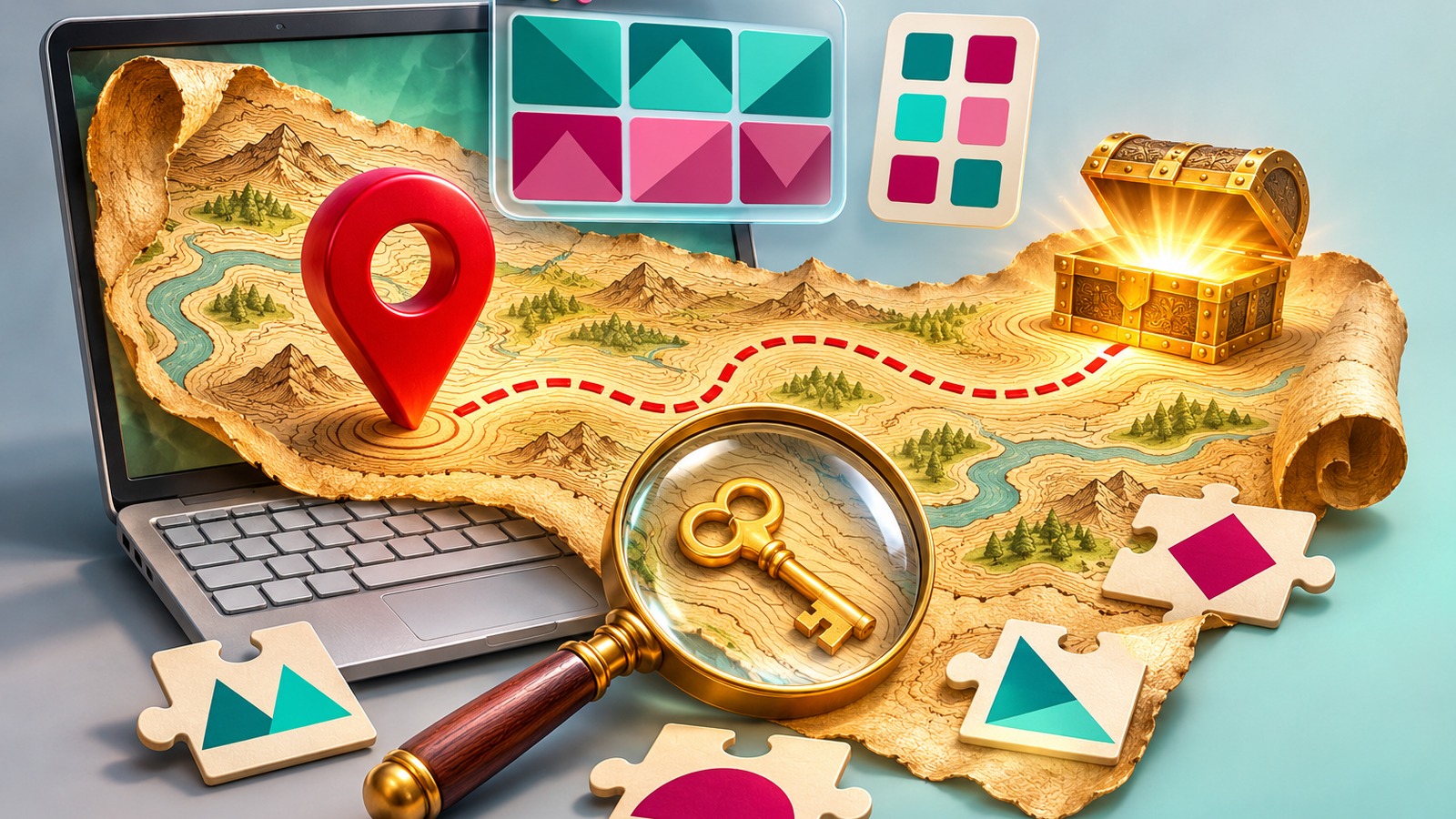
Pattern lock. A torn map shows dots with an X on one of them. Players draw the path from the ship to the X. The reveal gives the last digit.
Final numeric lock. The code is the first digit of lock 1, the number of letters in RIVER, and the digit from lock 4. With the example above, the map reveals a 3, so the final code is 753.
Put hints behind a delay, so a stuck team gets nudged after a few minutes and never has to quit.
What do the players see when the last lock opens?
In the finale, the pirate chest is the filmed unlock animation that fits this scenario. Lock Challenge locks open with filmed unlock animations: the object opens on video, with sound, when the right answer lands. Here the chest lid lifts and the coins burst out while the sound of clinking gold plays, and a celebration can follow. You can see it play on the pirate treasure template, and the custom virtual lock page shows the other filmed objects.
To turn this skeleton into your own hunt with a demo lock, start on the treasure hunt generator. You can build and preview a lock before paying anything. Players never pay and need no account.
Where online escape rooms break, and how to avoid it
Online escape rooms fail in three predictable ways: devices, answers and pacing. All three are fixable before the game starts.
Why do players get stuck on devices and wifi?
Six players around one phone is the classic trap. Give each pair a device, or put a short link and a QR code on a screen so anyone can join. In my own tests I always run the first lock myself on the venue's wifi before the guests arrive, because a locked-down corporate network is the failure nobody predicts.
Why does the answer check matter?
If the answer sits in the page code, the first curious teenager finds it. Lock Challenge checks answers on the server, which keeps a code from being read out of the browser. For the physical side of this debate, virtual vs physical locks compares what each does better.
How long should an online escape room be?
For kids, 20 to 30 minutes; the self-serve games above run 20 to 60 minutes, so that is the realistic range. For classroom use, the OECD publishes education research on collaborative problem solving, which is the skill a group puzzle exercises. A game that finishes in 15 minutes feels like a quiz, and one that drags past an hour loses the people who are not holding the keyboard. If you want a home version for a group, escape room at home lays out a one-evening plan, and DIY escape room goes step by step.
Verdict: which online escape room should you run?
Play a ready-made online escape room when you want one easy evening or a hosted game across time zones. Build a five-lock hunt when the audience is people you know. That is my recommendation for birthdays, classes and teams, because the personal clue is what everyone remembers.
An online escape room is a puzzle game played through a browser, an app or a video call, where players solve clues and enter codes into locks to reach a final reveal. Some are hosted by a live guide, and others are self-serve links. Lock chains you build yourself are a third format.
How long does an online escape room take?
Most self-serve games run 20 to 60 minutes, and hosted ones usually last about 60 minutes, according to the pages of online-escape-room.com and theescapegame.com in November 2026. A custom five-lock hunt for kids fits comfortably in 30 minutes.
Can I make an online escape room for my own group?
Yes. Write the story, chain three to five virtual locks, and share the first one as a link or a QR code. Pick lock types that suit the audience: numeric for kids, patterns and colours for visual clues, and GPS for outdoor hunts.
Do players need an account or an app?
Not with Lock Challenge. Players never pay and need no account; they open the link or scan the QR code on any phone or computer. Other platforms set their own rules, so check each one before inviting guests.
How much does it cost to build one?
Players never pay and need no account. See current plans and features on the pricing page.